
enne📚 reseñó As You Wake, Break the Shell de Becky Chambers
As You Wake, Break the Shell
4,0 stars
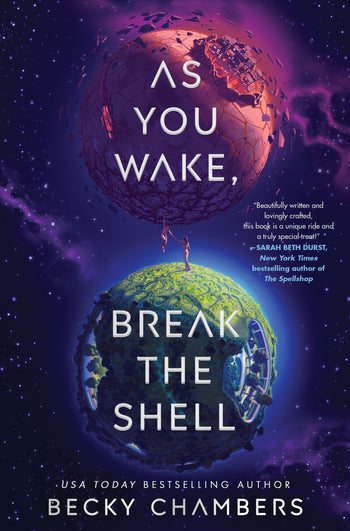
This is the first book in a new duology by Becky Chambers. It's tender, slow, internal. I think it would be weird to use the word "cozy" for a book about a struggling colony and grief, but on the other hand, this book is both gentle and heartwarming, focusing on support and connection. Even when the cause of strife is human-made, those forces are off-page, systemic, and anonymous.
It's set on the colony planet Fortune and the asteroid Cypsela, following the perspectives of both Cora the rorqual pilot and Signy the plant store owner in these two places at different points in time. I wonder how much my mixed feelings about this book are simply missed expectations that certain kinds of stories have certain kinds of shapes. As You Wake is the most romance-centered book I have ever read from Becky Chambers, and the relationship between Cora and Signy …
This is the first book in a new duology by Becky Chambers. It's tender, slow, internal. I think it would be weird to use the word "cozy" for a book about a struggling colony and grief, but on the other hand, this book is both gentle and heartwarming, focusing on support and connection. Even when the cause of strife is human-made, those forces are off-page, systemic, and anonymous.
It's set on the colony planet Fortune and the asteroid Cypsela, following the perspectives of both Cora the rorqual pilot and Signy the plant store owner in these two places at different points in time. I wonder how much my mixed feelings about this book are simply missed expectations that certain kinds of stories have certain kinds of shapes. As You Wake is the most romance-centered book I have ever read from Becky Chambers, and the relationship between Cora and Signy is the bulk of the story, both past and present. My romance genre (or even subgenre) expectation is that there's gotta be some rocky point or friction in the middle: some conflict, some tension, something that pulls them apart or makes it hard to stay together. Give the story a shape, please!
There's seeds for the possibility of conflict that never fully sprout: the complications around moving in together, Cora's indirect romance approach not meshing as well with Signy's no-nonsense desires or vice versa, Cora's job taking her away for weeks at a time, or even Signy's decisions around her secret job that also directly affect Cora and Colibri. And yet, apart from some momentary awkwardness, the two seem inseparably bound to each other with incredible trust and vulnerability. And, sure, it's comforting to see a queer romance where two people are attracted to each other, can be direct and honest about it (or at least one of them can), and then quickly grow close and supportive. It's especially true when we also get to see future vision of them being older and cornier and still just as supportive. It's cute; it's sweet; I just don't know that it makes for a strong story either?? I'm really struggling here to not make the classic accusation of "nothing happens" because that's both incredibly misleading and untrue—it more feels like there's a missed opportunity to have this romance more directly support what the book is doing thematically in other ways.
Structurally and thematically, this book is doing some things I really like. The opening interstitial explicitly tells the reader about the ways in which rorqual experience time differently and jump from topic to topic; unsurprisingly, the book follows two protagonists, and then mixes perspectives from them in the present and also ten years in the future along with interstitials. I could see an argument that this diffuses the tension of the story by seeing that in ten years both a romance and an escape of some sort have happened, but I don't think either of those things would have been a surprise to me as a reader; if anything, I think the intentionally deployed interleaving of character moments across time helps to chart internal arcs and growth.
Additionally, about halfway through, there's a section of chapters where it feels like each chapter is getting shorter and shorter until Chambers suddenly deploys the much longer "Chapters 13 & 775", where the reader simultaneously hears Signy and her future self give parallel monologues about seeds and eggs. The final two chapters of the book ramp up to a fragmented and frenetic shifting of moments and perspectives that create such tension and juxtaposition just by layering different scenes together. Truly, this last ten percent of the book is what changed my mind and won my heart.
To put this book in context of Becky Chambers' other work, it reminds me the most of Record of a Spaceborn Few. (Disclaimer: I quite liked that book, even if it felt contentious among my friends!) They are both quite internal and character-focused, full of small anecdotes rather than big drama. Both also weave in their themes quite strongly into the writing and dialog, and specifically have a lot to say about tradition, albeit in quite different directions. As You Wake specifically is about food and recipes and caring for your past by letting it grow and change (but also the costs and responsibilities of those steps). It's about plants and seeds and the struggle against the ill-fitting pot that constrains you. It's also about grief and loss and the impossibility of control.
And, for better or for worse, I'll mention again that this book is book one in a duology. It does not (and can not) end with the same sense of closure as her one-shot novels. It makes it hard to evaluate on its own merits. This is a conditional four stars from me if the next book sticks the landing, and a good bit less if it doesn't.
(Some bonus spoilery blabs if this hasn't been enough words already.)