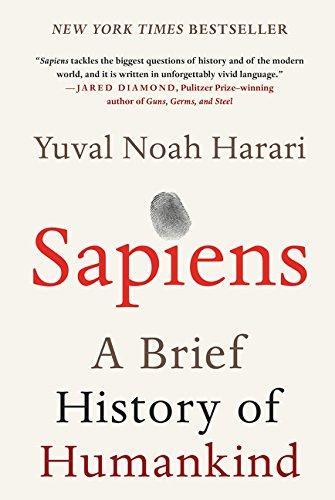
While reading through the last chapter, I recognize that Harari is himself a victim to the myths he so often talks about in the course of the book. The final pages of the book read like an advertisement for a venture-capital funded artificial intelligence startup that promises the future, while only caring about its owner's short-term wealth accumulation.
The core thesis that you are able to take away from this book, should you choose to do so, is that human societies and connections that go beyond the simple rural village or family clan require shared myths.
Harari calls everything a "myth" that doesn't exist in nature but is man-made. Be that religious beliefs, societal roles, money, the rule of law, a belief in individuality and human rights, capitalism, communism, and everything in between.
He manages to hold a position that calls religious beliefs an arbitrary invention, while simultaneously slamming militant atheists for rejecting religious beliefs wholesale because the atheist, too, shares beliefs (individualism, secularism, human rights, whatever you wish) that are ultimately cultural and made up by humans.
He attributes the fact that modern ideologies like capitalism, communism, imperialism, national socialism or feminism are not religions in a literal sense to medical progress and the reduction in child mortality in the modern era. If death is no longer a constant surrounding factor in your life, the capitalist, communist or feminist does not need to worry about promises of the afterlife, he says.
Another core observation he makes is that belief and hope in a better future did not necessarily exist in the Middle Ages and before in the way it does now. He says that pre-modern ideologies share the belief that the world is getting worse all the time, and the only way to make it better is to return to the golden age of the mythical past. Whereas a modern company manager cares to disrupt markets, the ancient priest thus saw heresy, the deliberate change of a prior-held belief, as sinful.
And he is not suggesting that this "progress" is a good thing, necessarily. He highlights at lengths how scientific progress in the age of "discovery" came hand-in-hand with the imperialist conquest of the world. You could say that the scientific progress of the past 500 years and our positive or optimistic views of the future are an unintentional side-effect of imperial conquest. At least, with the concepts Harari describes, this is a possible conclusion.
I really don't know what I think about this book and Harari's ideas in the end. I wonder how this book's conclusion would have looked like if it was written in the spring of 2025. Would he still postulate that soon humanity will create general artificial intelligence, androids, and genetically engineered superhumans?