
Brianna Dietz reseñó Day with No Words de Tiffany Hammond
A Day With No Words
5,0 stars
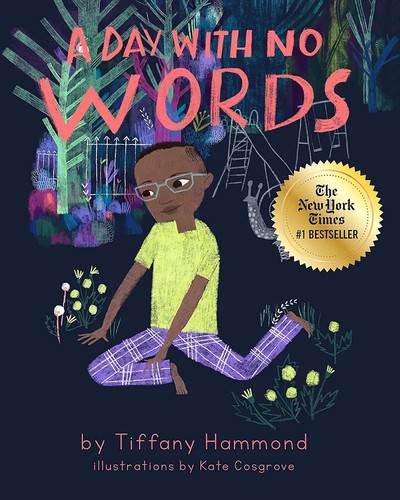
A Day with No Words is written by author Tiffany Hammond and illustrated by Kate Cosgrove. This book was published by Wheat Penny Press in 2023. I located this title through the Dis/ability, Access, & Inclusion Wakelet on the website of the Dolly Gray Children’s Literature Award. I was able to locate a physical copy of the book through my public library. A Day with No Words has received the Dolly Gray Children’s Literature Award and the CLEL Bell Award for TALK (Colorado Libraries for Early Literacy) in 2024. This book follows a young boy named Aidan who has autism and is non-verbal, he communicates using a tablet (an AAC device). The story follows Aidan and his mother as they spend the day together. They head to the park where Aidan loves to be. He likes to stare at things through his parted fingers, hug trees, and feel the soft …
A Day with No Words is written by author Tiffany Hammond and illustrated by Kate Cosgrove. This book was published by Wheat Penny Press in 2023. I located this title through the Dis/ability, Access, & Inclusion Wakelet on the website of the Dolly Gray Children’s Literature Award. I was able to locate a physical copy of the book through my public library. A Day with No Words has received the Dolly Gray Children’s Literature Award and the CLEL Bell Award for TALK (Colorado Libraries for Early Literacy) in 2024. This book follows a young boy named Aidan who has autism and is non-verbal, he communicates using a tablet (an AAC device). The story follows Aidan and his mother as they spend the day together. They head to the park where Aidan loves to be. He likes to stare at things through his parted fingers, hug trees, and feel the soft grass with his bare feet. As they play together, there are people walking in the park who give them stares and make a harmful comment about Adain, who is jumping and flapping with joy. The mother uses her AAC device to share in front of her son with those people that while he cannot speak with his voice, his ears can hear and understand their harmful words, which are harmful to his mind. Aidan continues to enjoy his time at the park, playing in the damp grass with his bare feet. After the park, Aidan and his mother head to a restaurant, proving that a day without words can still be enjoyable and fulfilling.
I really enjoyed reading this book because, while it uses a small amount of text, you can navigate what is happening in the story through the illustrations. The story can be told through the change of colors, the different facial expressions of characters, etc. I think I also felt an emotional feeling while reading this book because within the text, they don't tell you how the characters are feeling, they show you with their body language and facial expressions whether it was a positive or negative feeling. I also really enjoyed the amazing illustrations done by Cosgrove. She used a lot of color throughout the book, dark colors seemed to have portrayed a shift in mood in either the scene or the characters, and when there were vibrant colors, they emphasized more positive emotions and tone. I also really enjoyed how the illustrations were done from multiple different angles. Some were done close up on Aidan's face, others were done as a close up on his feet when he was touching the damp grass with his feet, and others were from a more standard angle. By doing this, I think the illustrator really helped to capture how a child might focus on these sensory details. Lastly, I liked how, most of the time when the AAC tablet was drawn, the tiles or words would fly from the screen and go out into the open space of the world. I think that the illustration of the AAC tablet being used is crucial in sending the message to a reader that even though these are not spoken words from a mouth, they are still real and powerful as spoken ones. The letters were also drawn in vibrant colors, which convey the power and positivity that Aidan has, even though he is not able to physically speak his thoughts.
I believe that this book is a perfect example of a contemporary realistic fiction book that focuses on the theme of disability. Instead of being inspirational or a character coming over their disability, this book just portrays an authentic look at a life with a non-verbal disability. The story never portrays Aidan as a character who is unable to do things or can eventually fix his disability, it portrays him as the narrator in the story. I believe that this is super powerful because it lets the reader know that just because Aidan cannot speak verbally does not mean that he does not have intellectual thoughts and emotions, it shows the complete opposite. Within Chapter 10 of Essentials of Children’s Literature, it talks about how children that read about other children's challenging situations can help those who are not facing these problems learn how to develop empathy as well as knowledge. I think that this book is a good example for readers to bridge the gap between understanding and showing empathy by putting oneself into Aidan’s shoes and feeling the emotion of what being non-verbal may feel, see, and look like to him, as well as potentially for others.
I think that this book can be used for grades K-3 (ages 5-9). In terms of using this book for literacy instruction, I think it would be a great resource to teach figurative language, as it emphasizes metaphors. In the book, Aidan uses many comparisons when he is talking at the beginning of the story to describe how voices and certain things make him feel. A potential activity with students can be having them write about a specific emotion they feel in a certain scenario, but they need to find a way to describe it without naming the emotion. I think this would also lead to teaching about the use of descriptive language. You can challenge students to move away from using words like ‘nice’ or ‘good’ and tap into the use of the ‘5 senses’ of see, touch, taste, feel, & smell. This can help students build a more diverse and expressive vocabulary. I think that this book can also be used to teach students the importance of looking at the illustrations, which can also help to tell the story. You can try by showing this book to the students the first time, by just showing the illustration and not reading the words. As you flip through the pages have students infer Adain’s, his mother’s, and even the people in the park's emotions by looking at their body and facial expressions, as well as the color of the illustrations.