
Un livre exelent, sur tout apres Boule de Foudre
5 estrellas
C'est la 2me fois que je le lis, et je l'ai appreciee encore plus, cette fois ci.
C'est la 2me fois que je le lis, et je l'ai appreciee encore plus, cette fois ci.
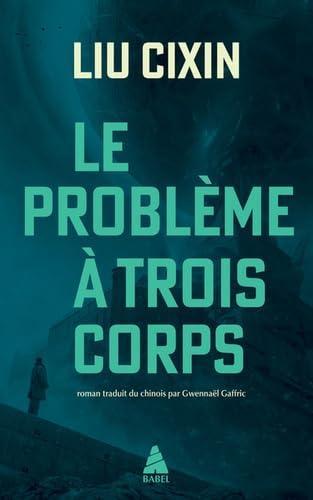
The Three-Body Problem (Chinese: 三体; lit. 'Three-Body'; pinyin: sān tǐ) is a science fiction novel by the Chinese writer Liu Cixin. The title refers to the three-body problem in orbital mechanics. It is the first novel of the Remembrance of Earth's Past (Chinese: 地球往事) trilogy, but Chinese readers generally call the whole series The Three-Body Problem. The trilogy's second and third novels are The Dark Forest and Death's End. The Three-Body Problem was serialized in Science Fiction World in 2006 and published as a book in 2008. It became one of the most popular science fiction novels in China. It received the Chinese Science Fiction Yinhe ("Galaxy") Award in 2006. A Chinese film adaptation of the same name was in production by 2015, but halted soon after. The English translation by Ken Liu was published by Tor Books in 2014. Thereafter, it became the first Asian novel ever to win …
The Three-Body Problem (Chinese: 三体; lit. 'Three-Body'; pinyin: sān tǐ) is a science fiction novel by the Chinese writer Liu Cixin. The title refers to the three-body problem in orbital mechanics. It is the first novel of the Remembrance of Earth's Past (Chinese: 地球往事) trilogy, but Chinese readers generally call the whole series The Three-Body Problem. The trilogy's second and third novels are The Dark Forest and Death's End. The Three-Body Problem was serialized in Science Fiction World in 2006 and published as a book in 2008. It became one of the most popular science fiction novels in China. It received the Chinese Science Fiction Yinhe ("Galaxy") Award in 2006. A Chinese film adaptation of the same name was in production by 2015, but halted soon after. The English translation by Ken Liu was published by Tor Books in 2014. Thereafter, it became the first Asian novel ever to win a Hugo Award for Best Novel, and was nominated for the Nebula Award for Best Novel.The series portrays a future where, in the first book, the Earth is awaiting an invasion from the closest star system, which in this universe consists of three solar-type stars orbiting each other in an unstable three-body system, with a single Earth-like planet unhappily being passed among them and suffering extremes of heat and cold, as well as the repeated destruction of its intelligent civilizations.
C'est la 2me fois que je le lis, et je l'ai appreciee encore plus, cette fois ci.
C'est la 2me fois que je le lis, et je l'ai appreciee encore plus, cette fois ci.
Terminado el primer libro de la trilogía. Sin aún conocer como serán el resto de libros de la saga, considero algo refrescante a lo que he leído en el género. Es un libro cuyo origen cultural es diferente al típico contexto occidental, ya que el libro fue escrito originalmente en Chino, aunque la traducción es muy buena, se nota algo en como se estructuran las ideas y las frases, entendería que a alguien le pueda resultar algo molesto pero para mi le da un valor añadido.
Esta historia empieza en la revolución cultural china, algo ya de por si, bastante interesante como occidentales, ya que la historia China no es algo a lo que aquí tengamos muchas nociones. Pero rápidamente avanza a un futuro próximo. Los demonios de la revolución cultural, como condición de partida en una acumulación de causas afectos (haciendo la analogía al problema físico al que …
Terminado el primer libro de la trilogía. Sin aún conocer como serán el resto de libros de la saga, considero algo refrescante a lo que he leído en el género. Es un libro cuyo origen cultural es diferente al típico contexto occidental, ya que el libro fue escrito originalmente en Chino, aunque la traducción es muy buena, se nota algo en como se estructuran las ideas y las frases, entendería que a alguien le pueda resultar algo molesto pero para mi le da un valor añadido.
Esta historia empieza en la revolución cultural china, algo ya de por si, bastante interesante como occidentales, ya que la historia China no es algo a lo que aquí tengamos muchas nociones. Pero rápidamente avanza a un futuro próximo. Los demonios de la revolución cultural, como condición de partida en una acumulación de causas afectos (haciendo la analogía al problema físico al que da el título a este libro) lleva a la humanidad a un futuro caótico donde se enfrentará a consecuencias impredecibles.
El libro aborda algunos de los problema clásicos de la ciencia ficción mientras desarrolla una compleja trama de investigación y misterio, sobre aparentes hechos sobrenaturales y extrañeces que están empujando a los científicos de primer nivel a la locura y la desesperación a lo largo y ancho del planeta tierra.
No es un libro perfecto, no se termina de desarrollar algunos conceptos que pone encima de la mesa y otros se simplifican, pero es un deleite poder leer referencias de física, matemáticas e incluso de computación y programación.
Con ganas de leer sus próximas partes.
I've read all three books before writing this review; and I can say: the first is the strongest and most exciting of the series. Hard science concepts are mixed with interesting characters and novel problems that may be feel a sense of scale and wonder as I read.
I've read all three books before writing this review; and I can say: the first is the strongest and most exciting of the series. Hard science concepts are mixed with interesting characters and novel problems that may be feel a sense of scale and wonder as I read.
Zeker niet het gemakkelijkste boek. De fysica van de drie lichamen en de wetenschap over subatomaire deeltjes gaat mijn petje soms te boven. Maar het verhaal greep me meteen aan en het boek vroeg gewoon om verder gelezen te worden.
Zeker niet het gemakkelijkste boek. De fysica van de drie lichamen en de wetenschap over subatomaire deeltjes gaat mijn petje soms te boven. Maar het verhaal greep me meteen aan en het boek vroeg gewoon om verder gelezen te worden.
Another mediocre read, I’m not having much luck at the moment! This started off so well, I was absolutely hooked by the clever, sophisticated scientific concepts and Liu’s easy writing style. The sections set in 1960s China were fascinating, it kind of felt like a sweeping historical sci-fi. I was also really invested in the main characters early on, and I especially loved Da Shi, the noir-ish detective with a bit of an attitude.
But then somewhere around the halfway mark things got really bogged down with the science, in fact the science became the main character. The scientific concepts became very hard for a casual reader to grasp and Liu would spend pages, sometimes entire chapters, dissecting and analysing these complex ideas. Quite frankly, I got bored and felt quite alienated as a reader. All of the momentum went out of the storytelling and character development, which just felt …
Another mediocre read, I’m not having much luck at the moment! This started off so well, I was absolutely hooked by the clever, sophisticated scientific concepts and Liu’s easy writing style. The sections set in 1960s China were fascinating, it kind of felt like a sweeping historical sci-fi. I was also really invested in the main characters early on, and I especially loved Da Shi, the noir-ish detective with a bit of an attitude.
But then somewhere around the halfway mark things got really bogged down with the science, in fact the science became the main character. The scientific concepts became very hard for a casual reader to grasp and Liu would spend pages, sometimes entire chapters, dissecting and analysing these complex ideas. Quite frankly, I got bored and felt quite alienated as a reader. All of the momentum went out of the storytelling and character development, which just felt criminal as they were such interesting characters. It was such a disappointing turn of events as I was loving it up until this point, and was so excited to read the other books in the trilogy.
És un llibre enrevessat amb un punt psicodèlic interessantíssim i utilitzant la cultura xinesa com a base que això, des del nostre occident mediterrani, el fa suggerent. T'obliga a repensar els límits del nostre propi pensament i, fins i tot, algunes creences. Un d'aquells llibres de ciència-ficció que són complets, que ho aborden tot. A vegades em recorda a la Fundació, a la Fi de la Infància o fins i tot a Encontres amb Rama.
És un llibre enrevessat amb un punt psicodèlic interessantíssim i utilitzant la cultura xinesa com a base que això, des del nostre occident mediterrani, el fa suggerent. T'obliga a repensar els límits del nostre propi pensament i, fins i tot, algunes creences. Un d'aquells llibres de ciència-ficció que són complets, que ho aborden tot. A vegades em recorda a la Fundació, a la Fi de la Infància o fins i tot a Encontres amb Rama.
I liked the plot and the unusual idea for the story, but the characters are somehow not so well detailed and it was hard to immerse myself into the book. Nevertheless, I'm going to read the second one in this series.
I liked the plot and the unusual idea for the story, but the characters are somehow not so well detailed and it was hard to immerse myself into the book. Nevertheless, I'm going to read the second one in this series.
Advertencia de contenido This book is intensely political.
Everyone loves this, but I can't understand why nobody seems to be put off, or at least puzzled, but the way that every human individual or organization in the book is just relentlessly awful, ranging from suicidal to genocidal, and everything in-between, without respite.
Most of them, given any chance at all, are trying hard to selfishly save their own skins, with not a moment's regard for the fact that their plans will immediately doom the rest of the human race. Those not intent on self preservation at any cost are instead committed to bitter nihilism, such as the ultimate eco-terrorists, who feel that to save the Earth's biosphere they must collaborate with alien forces to bring about humanity's defeat, and likely annihilation.
These characters and groups are not depicted as outliers. They represent the human race in its entirety. The only thing that holds back this tide of destructive behavior is the government, who keeps everyone in line.
I can't tell how much of this bizarrely one-sided depiction of humanity is a deliberate choice by the author, versus simply being an unplanned exposure of their worldview, shaped as it is by their native Chinese immersion in authoritarianism. Does that form a subconscious backdrop to everything they wrote here, or are they consciously making a deliberate point that strong government is absolutely necessary?
The author Liu Cixin has since gone on record in support of the Chinese government's internment of Muslim Uighurs in Xinjiang. There, people have been rounded up, because of their ethnicity, into over 400 internment camps. The camps administer cultural and religious re-education, forced labor, involuntary sterilization and abortion. This is something Liu Cixin is openly in favor of.
It makes my skin crawl to read that, and then carry on blithely with this story book of theirs, which seems to be an unapologetic justification for an authoritarian government's impositions on its populate. I did finish it, but have no desire to read the sequels - and not just because I don't agree with the politics. I genuinely found the behavior of all the characters to be intrusively bewildering, demented and incessantly frustrating.
A good hard fiction novel that explores the question of making first contact. It's a quick read that has decent character development, a smooth flowing plot, and asks deep philosophical science questions.
A good hard fiction novel that explores the question of making first contact. It's a quick read that has decent character development, a smooth flowing plot, and asks deep philosophical science questions.
Ich hab innerhalb von zwei Tagen "Die Drei Sonnen" von Cixin Liu gelesen. Das hatte ich schon sehr lange auf meiner Liste und erfreulicherweise waren alle drei Bände der Trilogie in der Stadtbücherei vorrätig.
Die knapp 550 Seiten haben sich schnell und angenehm gelesen. Das Meisterwerkgefühl bliebt bei mir jedoch leider aus.
Die Geschichte ist nett, aber jetzt nichts neues, vieles wirkt eher konstruiert und anstatt Entdeckung wird eher präsentiert.
Ich hab innerhalb von zwei Tagen "Die Drei Sonnen" von Cixin Liu gelesen. Das hatte ich schon sehr lange auf meiner Liste und erfreulicherweise waren alle drei Bände der Trilogie in der Stadtbücherei vorrätig.
Die knapp 550 Seiten haben sich schnell und angenehm gelesen. Das Meisterwerkgefühl bliebt bei mir jedoch leider aus.
Die Geschichte ist nett, aber jetzt nichts neues, vieles wirkt eher konstruiert und anstatt Entdeckung wird eher präsentiert.